Showing posts with label Romania. Show all posts

Thursday, April 2, 2026

Romania - Bucharest, Victory Avenue

Bucuresti (Bucharest) Calea Victoriei (Victory Avenue)


Friday, January 23, 2026

Romania - Eforie Nord

Eforie Nord in Romania 


Wednesday, November 30, 2016

Romania - Alba Iulia, Poarta a III-a a Cetatii, Gate 3

Alba Iulia - Romania
Traseul celor trei fortificatii - Poarta a-III-a
(The route of the three strongholds - Gate III)
2016

- - - - - - -

Alba Iulia is a city located on the Mureş River in Transylvania, Romania, with a population of 63,536 as of 2011.  

Thursday, February 11, 2016

Romania - Bucuresti, Bucharest

Bucuresti (Bucharest)
Centrul Vechi (Old Town)
2015

The sender writes:

Romania offers a rich tapestry of tourist attractions and vacation experiences unique in Central-Eastern Europe: medieval towns in Transylvania, the world-famous Painted Monasteries in Bucovina, traditional villages in Maramures, the magnificent architecture of Bucharest, the romantic Danube Delta, fairy-tale castles, the Black Sea resorts, the majestic Carpathian Mountains, spas and much more! 

Tuesday, November 18, 2014

Romania - Constanta, The Old Town

Constanta - Constantza

Orasul vechi - The old Town

Foto: Nicu Triculescu, 2001

- - - - - - - - - - -

Constanţa is one of the oldest cities in Romania, founded around 600 BC. The city is located in the Dobruja region of Romania, on the Black Sea coast. It is the capital of Constanţa County and the largest city in the region.

The Port of Constanţa has an area of 39.26 km2 (15.16 sq mi) and a length of about 30 km (19 mi). It is the largest port on the Black Sea, and one of the largest ports in Europe.

Saturday, November 15, 2014

Romania - Bran Castle (Dracula)

Bran Castle (Also known as Dracula's Castle)
Castelul Bran
2010

- - - - - - - - - -

Bran Castle, situated near Bran and in the immediate vicinity of Braşov, is a national monument and landmark in Romania. The fortress is situated on the border between Transylvania and Wallachia. Commonly known as "Dracula's Castle", it is marketed as the home of the title character in Bram Stoker's Dracula.

There is evidence that Vlad Tepes actually did use the castle during his raids into Transylvania.

The castle is now a museum open to tourists, displaying art and furniture collected by Queen Marie. Tourists can see the interior individually or by a guided tour. At the bottom of the hill is a small open air museum park exhibiting traditional Romanian peasant structures (cottages, barns, etc.) from across the country.

- - - - - - -


Vlad Tepes - (Face you see at the bottom of the postcard) (November 1431 – December 1476), more commonly known as the Impaler or Dracula, was a three-time ruler of Wallachia, ruling mainly from 1456 to 1462.

Historically, Vlad is best known for the cruel punishments he imposed on his enemies.  (Impalement was his favorite choice of execution)
In the English-speaking world, Vlad III is perhaps most commonly known for inspiring the name of the vampire in Bram Stoker's 1897 novel Dracula.

Friday, November 14, 2014

Thursday, November 13, 2014

Romania - Bran Castle in Winter

Castelul Bran
(Bran Castle)
2010

Romania - Castle, UNESCO, Fortress, Church

Romania

(1-3 is the top row
4-5 bottom row...)

1. Castelul Bran (Bran Castle)
2. Delta Dunarii  (The Danube Delta - UNESCO site)
3. Cetaea Rasnov (The Rasnov Fortress)
4. Biserica fortificata Biertan (The Fortified Church Biertan)
5. Manastirea Moldovita (Moldovita Monestary)
2010

- - - - - - - - - - -

The Danube Delta is the second largest river delta in Europe, after the Volga Delta. The greater part of the Danube Delta lies in Romania (Tulcea county), while its northern part, on the left bank of the Chilia arm, is situated in Ukraine.

Romania - Village Museum, Muzeul Satului

Romania - Bucuresti - Muzeul Satului
(Romania - Bucharest - Village Museum)

Art by Rosu in 2008

I would LOVE to get more postcards of this Museum!

- - - - - - - - - -

The Village Museum (Muzeul Satului in Romanian) is an open-air  museum showcasing traditional Romanian village life. The museum extends to over 100,000 m2, and contains 272 authentic peasant farms and houses from all over Romania.

Friday, October 24, 2014

Romania - Sighisoara - The Clock Tower

Sighisoara

Romania - Sighisoara - The Clock Tower
2010

- - - - - - - - - - -

Sighişoara is a city and municipality located in the historic region Transylvania, Sighişoara has a population of  around 33,000.

The Clock Tower  was built in 1360 and stands at 60 meters tall atop the citadel hill. Inside is a museum with a great view from the top.

Saturday, October 18, 2014

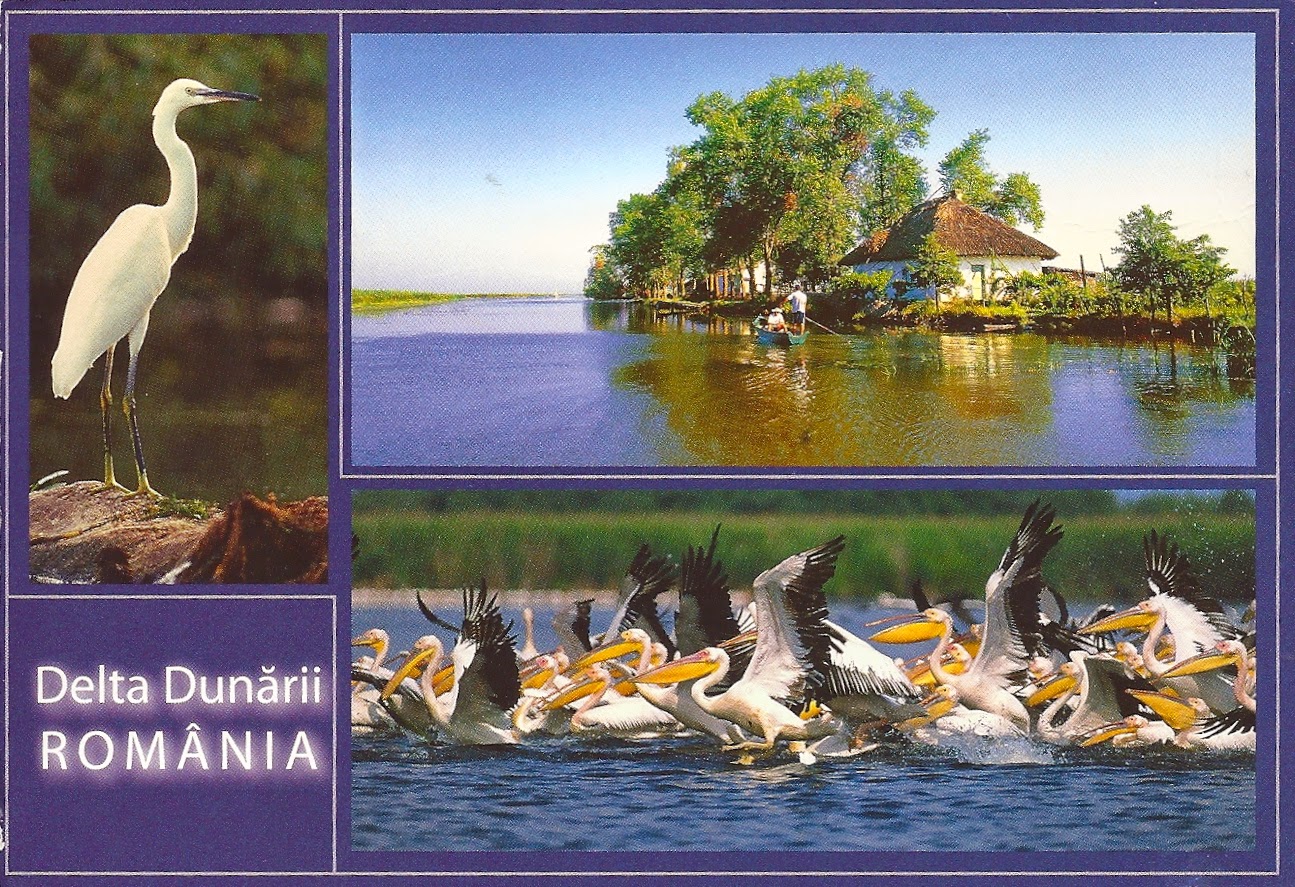
Romania - Danube Delta, Multiview

Delta Dunarii
The Danube Delta

Romania

This postcard features an egret or heron and the White Stork birds.
2010

- - - - - - - - - - - - - - - - - - - - - - -

The Danube Delta is the second largest river delta in Europe, after the Volga Delta. The greater part of the Danube Delta lies in Romania (Tulcea county), while its northern part, on the left bank of the Chilia arm, is situated in Ukraine (Odessa Oblast). It is an UNESCO World Heritage Site.

Wednesday, June 11, 2014

Romania - The Black Church in Brasov

Brasov

Romania - Brasov, Brasov: Biserica Neagra
Romania - Brasov, Brasov: The Black Church

- - - - - - - - - - - - - - - - - - - - - - -

Biserica Neagră or Black Church is a cathedral in Braşov, a city in south-eastern Transylvania, Romania. It was built by the German community of the city and stands as the main Gothic style monument in the country, as well as being the largest and one of the most important Lutheran places of worship in the region.

Romania - Targoviste, Metropolitan Church and Ruins of Castle

Targoviste
Mitropolia Targoviste - ruinele palatului mitropolitan
Targoviste Metropolitan Church - Ruins of the Metropolitan Castle

Foto: O. Ploscaru

Thursday, June 5, 2014

Romania - Unique Places of Romania

Unique Places of Romania

Bran Castle, Sinaia - Peles Castle, Brasov - Black Church
2010

Monday, April 21, 2014

Romania - Multiview Sites of Romania

Romania

1. Piata Mica / Sibiu
2. "Babele" / Muntii Bucegi
3. Biserica Rozavlea / Maramures
4. Palatul de Justitie / Bucuresti
5. Manastirea Sambata / Brasov

from google translate:
1. Piata Mica / Sibiu
2. "Old Women" / Bucegi
3. Church Rozavlea / Maramures
4. Palace of Justice / Bucharest
5. Saturday Monastery / Brasov

Foto: Dragos Grigore
2011

Saturday, March 29, 2014

Romania - Mitropolia Moldovei si Bucovinei, Iasi (Metropolis of Moldavia and Bukovina)

Mitropolia Moldovei si Bucovinei, lasi
(Metropolis of Moldavia and Bukovina in Lasi, Romania)
2011

 - - - - - - - - - - - - - - - - - - - - - - - - - - - - - -

The Metropolitan Cathedral, Iaşi is the seat of the Romanian Orthodox Archbishop of Iaşi and is the largest Orthodox church in Romania. It is listed in the National Register of Historic Monuments.

Two churches previously stood on the site: the White Church (15th century) and the Presentation Church (17th century). On 8 August 1826, prince Ioan Sturdza signed a decree ordering construction of the cathedral; Metropolitan Veniamin Costachi laid the cornerstone on 3 July 1833 and guided construction in its early years. Work began in 1833, and continued at a rapid pace until 1839. In 1840, after serious cracks had appeared on the large central arch, the brick ceiling was replaced with wood. On 23 May 1857, the central vault collapsed taking the interior columns with it, and the church remained unused for the next 25 years.

With some encouragement, the newly-independent Romanian state decided to resume work on the cathedral. A new cornerstone was laid on 15 April 1880. Alexandru Orăscu, rector of the University of Bucharest, designed new plans that added two rows of massive pilasters to the interior, creating a rectangular basilica shape. The four detached side spires were kept, but the large central dome was eliminated and replaced with a system of four semicircular sections, separated by arches.

The cathedral was completed in 1887 and consecrated on 23 April that year in the presence of King Carol I and Queen Elisabeth, who had donated large sums for the project. In 1889, the relics of Saint Paraschiva, patron saint of Moldavia, were brought from Trei Ierarhi Monastery. 

Sunday, November 24, 2013

Romania - Moldovita Monastery, Church - UNESCO

Romani
Biserica Manastirii Moldovita (1532)
2013

- - - - - - -

Stephen the Great, the King (in Romanian Domnitor) of Moldavia from 1457 until his death in 1504, fought 36 battles against the Ottoman Empire, winning 34 of them. He was very religious and built churches after many victories. Stephen's illegitimate son, Petru Rareș, who ruled Moldavia from 1527 to 1538 and again from 1541 to 1546, promoted a new vision for Bukovina churches. He commissioned artists to cover the interiors and exteriors with elaborate frescoes (portraits of saints and prophets, scenes from the life of Jesus).

The best preserved are the monasteries in the towns of Sucevița, Moldovița, Voroneț, Humor, Suceava, Pătrăuți, Arbore and Probota. These eight monasteries, including the Monastery of Moldovița in the postcard above, were placed on UNESCO World Heritage list in 1993.

Sunday, November 17, 2013

Romania - Maramures, Viseu De Sus, Train and Man Driving Horses

CFF Viseu de Sus, Maramures, Romania
2013

- - - - - - -

A Mocăniță is a narrow gauge railway in Romania, most notably in Maramureș, Transylvania, and Bukovina. They are now used mostly for tourism.

Wednesday, March 14, 2012