Showing posts with label Greece. Show all posts

Wednesday, April 29, 2026

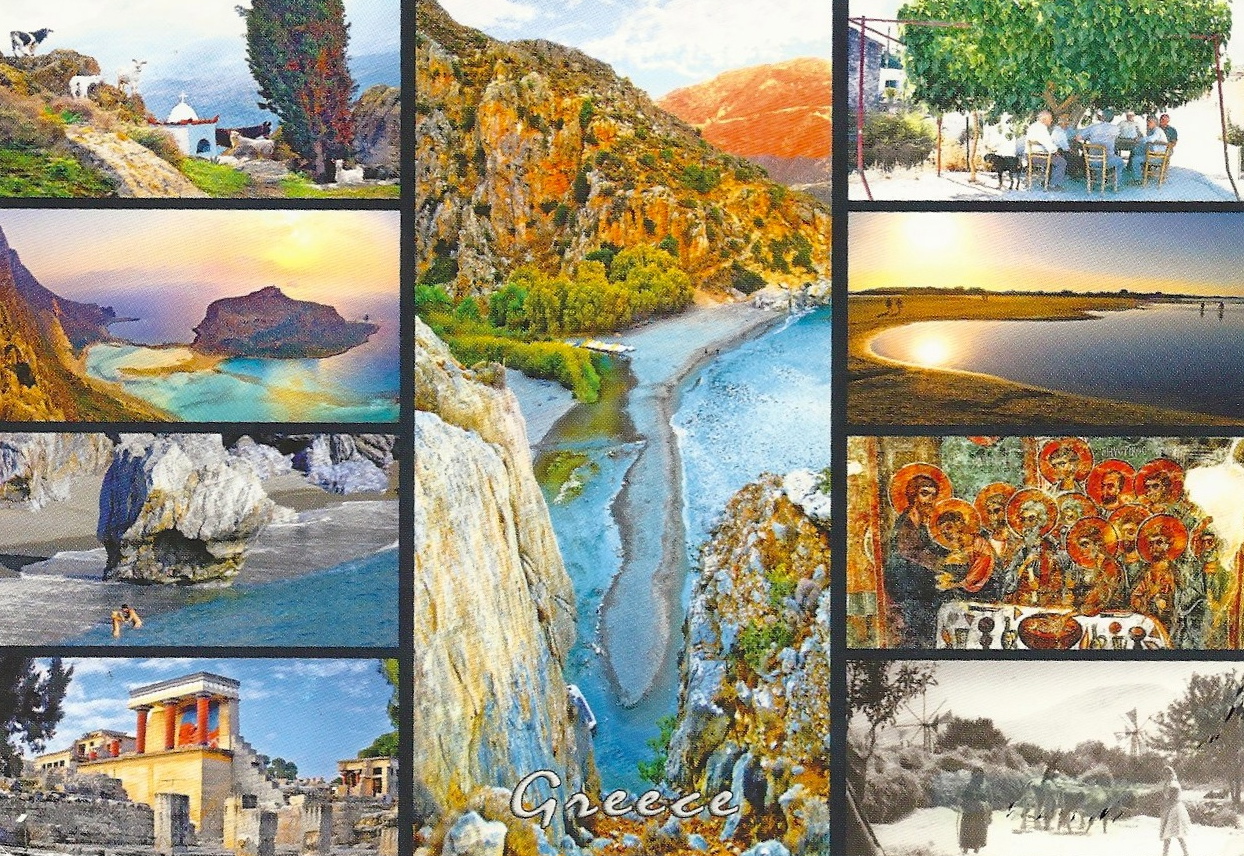
Greece - Crete, A Sticker Postcard

Kisses from Crete, Greece

This is a sticker postcard and was mailed in 2022.


Wednesday, December 3, 2025

Greece - Rhodes, Palace of the Grand Masters of the Knights of St. John

The imposing Palace of the Grand Masters of the Knights of St. John - Rhodes, Greece 


Monday, October 19, 2015

Wednesday, March 18, 2015

Greece - Crete

Greece - Grece - Griechenland - Grecia
Photos by Stavros and Kostas Marmatakis, Crete
2014

Tuesday, February 10, 2015

Greece - Athens: Temple of Hephaestos

Athens: The temple of Hephaestos (Theseion)
1979

- - - - - - -

The Temple of Hephaestus (shown in the upper left of the postcard), is a well-preserved Greek temple; it remains standing largely as built.  From the 7th century until 1834, it served as the Greek Orthodox church of St. George Akamates.

The church in the front of the card is:
The Church of the Holy Apostles, also known as Holy Apostles of Solaki, is located in the Ancient Agora of Athens, Greece, and can be dated to around the late 10th century.

Thursday, December 18, 2014

Greece - Spetses, (Two Postcards)

Spetses, Greece
2009
- - -
Argosaronic (The Gulf)
Spetses, Greece
2009

- - - - - - - - - -

Spetses is an island of Greece, sometimes included as one of the Saronic Islands.  The town of Spetses (pop. 3,846 in 2001) is the only large settlement on the island.

Ferries and high-speed hydrofoils arrive regularly on the island.  The use of motor vehicles is severely restricted on the island, so the public transportation system is generally provided by horse & carriage and water taxis. Some conventional taxis and buses are in operation, but they require a special license. The inhabited area is so compact that most people use scooters, bicycles or walk throughout the island.  

Tuesday, November 18, 2014

Greece - Acropolis Museum, the Caryatids

Experimenting with the placement of the Caryatids in the new Acropolis Museum
2010

- - - - - - - - - -

A caryatid is a sculpted female figure serving as an architectural support taking the place of a column or a pillar supporting an entablature (moldings and bands which lie horizontally above column) on her head.

The Acropolis Museum is an archaeological museum focused on the findings of the archaeological site of the Acropolis of Athens. The museum was built to house every artifact found on the rock and on its feet, from the Greek Bronze Age to Roman and Byzantine Greece. It also lies on the archaeological site of Makrygianni and the ruins of a part of Roman and early Byzantine Athens.

The museum was founded in 2003 while the Organisation of the Museum was established in 2008. It opened to the public on June 21, 2009. Nearly 4,000 objects are exhibited over an area of 14,000 square metres.

Monday, June 9, 2014

Tuesday, April 22, 2014

Greece - Mykonos, A Pelican on a Log

Grece
Greece
Griechenland

Mykonos, Le pelican “Petrus”
Mykonos, The Petter
Mykonos, Der Pelikan Petrus

- - - - - - -

Mykonos is a Greek island, part of the Cyclades. The island spans an area of 85.5 square kilometres (33.0 sq mi) and rises to an elevation of 341 metres (1,119 feet) at its highest point. 

Saturday, March 29, 2014

Greece - Athens, Greek Ruins, 3-D Raised Image

Greek Ruins, Athens, Greece
2011

This is from of a set of eight postcards called: 3D 'Raised Images'. 

Thursday, December 19, 2013

Greece - Seaside Village at Sunset

Greece
2011

I would love to stay in a place like this for a while!  I bet the sounds of the waves at night make you sleep like a baby.

Monday, December 2, 2013

Greece - Delphi, Treasury of the Athenians, Past and Present in 3-D

Delphi, the Treasury of the Athenians, late 5th century BC
This was built of Paros marble in the style of a Doric temple with dimensions 9.7m x 6.7m.  The sculptures on the frieze are replicas and the originals are in the Delphi museum.

This is a 3-D postcard.  One part shows what it looks like today, then when you tilt the card, it shows, with drawings, what it looked like back when it was built.
2011

Greece - Corinth Canal

Corinth Canal

Excavations of Corinth anal 1882 - 1893

Length 6.343 meters (3.9 miles)
Width 25 meters (79 feet)
Water depth 8 meters (26 feet)
Highest point from sea level 79 meters
2011

- - - - - - - - - - - - - - - - - - - - - - - - - - - - - - -

Several rulers in antiquity dreamed of cutting a canal through the Isthmus. The first to propose such an undertaking was the tyrant Periander in the 7th century BC. He abandoned the project due to technical difficulties, and instead constructed a simpler and less costly overland portage road, named Diolkos. According to another theory, Periander feared that a canal would have robbed Corinth of its dominating role as entrepôt for goods.

The Diadoch Demetrius (336–283 BC) planned to construct a canal as a means to improve his communication lines, but dropped the plan after his surveyors, miscalculating the levels of the adjacent seas, feared heavy floods.

The historian Suetonius tells us that the Roman Dictator Julius Caesar (r. 49-44 BC) projected, among other grandiose engineering schemes, a canal through the Isthmus. He was assassinated before he could bring the scheme to fruition.

The Roman Emperor Nero (r. 54–68 A.D.) launched an excavation, personally breaking the ground with a pickaxe and removing the first basket-load of soil, but the project was abandoned when he died shortly afterwards.

The modern attempt at construction began in the 1870s following the successful opening of the Suez Canal. A French company was hired to build it, but due to financial difficulties, the company ceased work after only the two ends had been dug. Finally, in 1881 the Hungarian architects István Türr and Béla Gerster, who had also been involved with early surveys for the Panama Canal, were hired to plan a new canal. A Greek company led by Andreas Syngros (the main contractor being Antonis Matsas) ultimately took over the project and completed it in 1893.

Greece - Athens, Tsoliades or Evzones from the Greek Army

Athens
Tsoliades
2011

- - - - - - - - - - - - - - - - - - - - - - -

The Evzones, or Evzoni, (Tsoliades) is the name of several historical elite light infantry and mountain units of the Greek Army. Today, it refers to the members of the Proedriki Froura (Presidential Guard), an elite ceremonial unit that guards the Greek Tomb of the Unknown Soldier, the Hellenic Parliament and the Presidential Mansion.

Though the Presidential Guard is a predominantly ceremonial unit, all Evzones are volunteers drawn from the Hellenic Army's Infantry, Artillery and Armoured Corps. Prospective Evzones are usually identified at the Army Recruit Training Centres during Basic Training; there is a minimum height requirement of 1.86 meters to join, and the soldier must serve a minimum of 6 months with an operational Army unit before beginning Evzone training.

The unit is famous around the world for its unique traditional uniform, which has evolved from the clothes worn by the klephts who fought the Ottoman occupation of Greece.  Their proven valour and peculiar dress turned them into a popular image for the Greek soldier, especially among foreigners.

Thursday, September 19, 2013

Greece - Mykonos


Mykonos

photo by Michalis Toubis / Nisiza karela
2013

- - - - - - -

Mykonos is a Greek island that is part of the Cyclades. The island spans an area of 85.5 km2 (33 sq mi) and rises to an elevation of 341 m (1,119 ft) at its highest point. As of 2011, there was a population of around 10,100 people most of whom live in the largest town, Mykonos, which lies on the west coast.


Sunday, September 8, 2013

Greece - Crete, Multiview


Crete
2011

- - - - - - - - - - - - - - - - - - - - - -

Crete is the largest and most populous of the Greek islands and the fifth largest island in the Mediterranean Sea. It forms a significant part of the economy and cultural heritage of Greece while retaining its own local cultural traits (such as its own dialect, poetry, and music).

It was the centre of the Minoan civilization (c. 2700–1420 BC), the first civilization in Europe and the first European country with a palace (at Knossos).

Saturday, June 23, 2012

Greece - Woman Baking Bread


Outdoor Wood Burning Oven

This lady looks amazing!  I wonder how many loaves she has made in her lifetime.

Postmarked in 2011 with two Greece (Hellas)

Here is a recipe I found for a classic Greek bread (It says that it is a bit more dense than regular bread) :

Prep Time: 3 hours, 20 minutes

Cook Time: 30 minutes

Total Time: 3 hours, 50 minutes

Ingredients:

1 ounce of fresh yeast or 2 tablespoons of dry yeast
1/2 cup (4 fl.oz) of lukewarm water
1/2 cup (62g) of flour (whatever type used for bread)
2 1/5 pounds (1 kilo / 8 cups) of bread flour (whole wheat, barley, white, corn, or other)
1 tablespoon of salt
2 1/2 cups (20 fl.oz) of lukewarm water
2 tablespoons of milk
2 tablespoons of olive oil
2 tablespoons of honey
Preparation:

In a small bowl, dissolve the yeast in lukewarm water. Slowly add the 1/2 cup of flour and mix until all lumps of flour have dissolved, to form a thick liquid. Allow to rise about 15-20 minutes.

For a thicker crust, score the tops of the loaves in 3 or 4 places (like you see on the postcard). Otherwise, bake as is on the rack just below the middle of the oven for 30-35 minutes until browned. When tapped on the bottom, bread will sound hollow.

When the loaves are done, remove from oven and cool on racks.

Thursday, June 21, 2012